
PDF invoice
- ·Human-readable document
- ·Usually attached to email
- ·Data often needs manual processing
- ·Not sufficient by itself for in-scope Belgian B2B structured e-invoicing
PEPPOL & STRUCTURED E-INVOICING
Create and send structured invoices from the same Snapfact workspace you already use for your business.
Snapfact handles the e-invoicing workflow while Peppol connects your business securely to customers and suppliers.
FIRST, WHAT CHANGED?
From 1 January 2026, structured electronic invoicing became mandatory for nearly all in-scope B2B transactions between Belgian VAT-liable businesses.
A normal PDF attached to email is not a structured electronic invoice.
STRUCTURED
WHAT IS PEPPOL?
Your customer does not need to use Snapfact. Your supplier does not need to use Snapfact. Their software only needs to connect to the Peppol network through a compatible Peppol service provider.
Your business → Snapfact → Peppol service provider → PEPPOL NETWORK → Recipient's service provider → Customer system. Sender and receiver do not need to use the same software or provider.
CLEAR THE CONFUSION
Three things Peppol is not — so you know what stays in Snapfact.
You continue working in Snapfact.
Peppol carries structured business documents between systems.
Different Peppol-connected platforms can exchange documents.
ONE COMMON LANGUAGE
Peppol uses standardised document specifications so invoice software can understand the same core information: supplier, customer, amounts, VAT, payment details and invoice lines.
EN 16931
European semantic standard for electronic invoices.
Peppol BIS Billing 3.0
Practical Peppol specification based on that standard.
UBL
Structured machine-readable document format used to carry invoice data.
YOUR ADDRESS ON THE NETWORK
Think of it as the business address used by Peppol to identify the receiving organisation. For Belgian businesses, identifiers are commonly linked to official business or VAT identity.
Customers normally should not have to maintain a manual Peppol address book. Where the workflow supports it, Snapfact performs recipient lookup.
SENDING
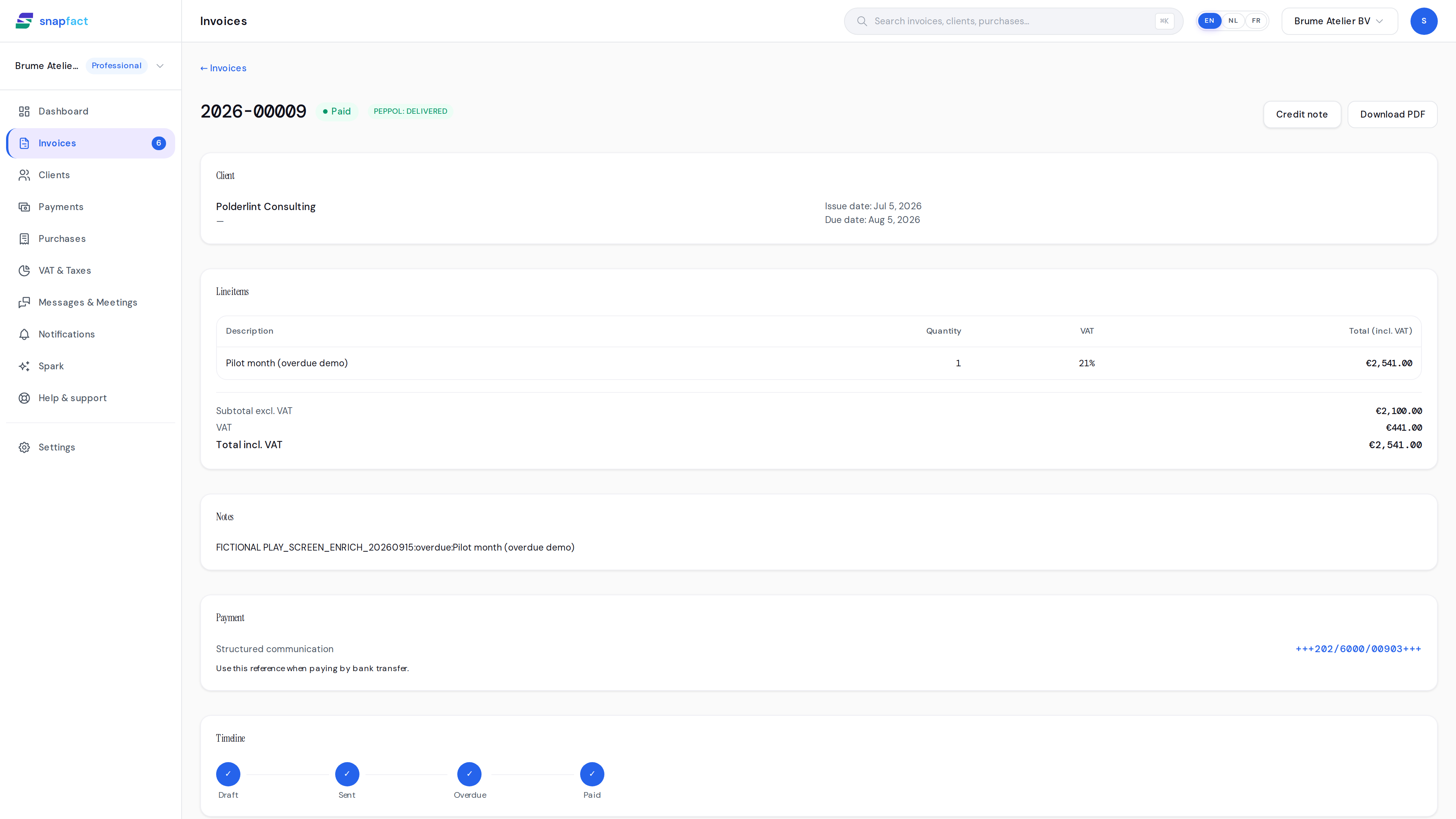
Peppol delivery is built into the Snapfact invoice workflow — not a separate export process.
Peppol network delivery is enabled after business verification and Peppol activation for your organisation.
Create
Create the invoice normally in Snapfact.
Check
Snapfact checks required invoice information.
Find
Where supported, Snapfact determines whether the recipient is reachable through Peppol.
Structure
Snapfact prepares the structured invoice document.
Send
When Peppol sending is activated, the invoice is routed through the Peppol network.
Track
Snapfact records transmission and status information returned to the platform.
ACTIVATION
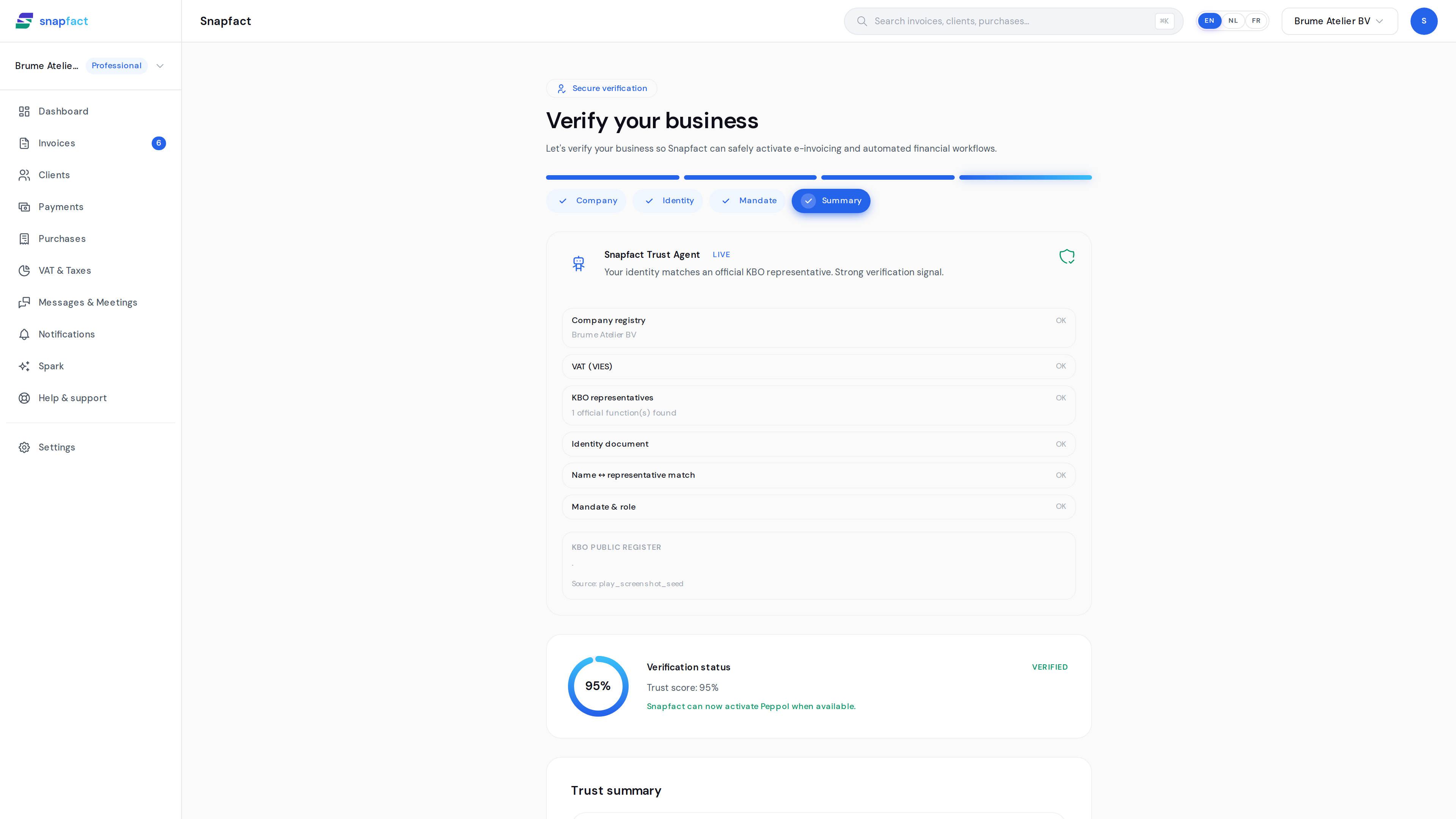
Before Peppol sending is activated, Snapfact verifies the business and the authority of the person activating the service. Peppol represents a real business identity — we do not activate sending merely because someone created an account.
This protects businesses against unauthorised activation and document sending.
Company details
Confirm your organisation identity.
Representative verification
Verify the person activating the service.
Authority confirmation
Confirm mandate or authority where required.
Peppol activation
Enable Peppol connectivity for the organisation.
RECEIVING
Belgian businesses must also be able to receive structured invoices. Receiving support in Snapfact is being activated progressively as Peppol connectivity is enabled for each organisation.
Inbound purchase handling for supported Peppol documents follows your organisation’s Peppol activation — it is not a separate product.
CLEAR ROLES
Snapfact provides the user-facing workflow and connects your business to Peppol through Peppol service-provider infrastructure.
STATUS & DELIVERY
Snapfact tracks transmission status for Peppol documents in your workspace.
Peppol delivery status is not the same thing as payment status.
BELGIAN SCOPE
High-level orientation — not exhaustive legal advice.
Not sure? Check the official Belgian e-invoicing guidance or ask your accountant.
Generally mandatory for in-scope transactions between Belgian VAT-liable businesses from 1 January 2026.
The B2B structured-invoicing obligation does not generally apply to invoices sent to private consumers.
Structured e-invoicing already applies broadly to Belgian public procurement, subject to applicable rules.
Rules can differ depending on the transaction and parties involved.
Official information: Belgian e-invoicing portal →
WHEN LOOKUP FAILS
Snapfact can show whether the recipient is reachable through the supported Peppol workflow.
For Belgian B2B invoices within the mandatory structured e-invoicing scope, a PDF by email alone is generally not a valid replacement for the required structured invoice.
For transactions outside the mandatory B2B scope, another delivery method may be appropriate depending on the situation and applicable rules.
RELATED
Peppol sits inside Snapfact — alongside accountant collaboration and Spark.
ALLOWANCES
Plans can include a monthly Peppol document allowance, with additional usage handled according to the selected plan.
FAQ
Peppol is an interoperability framework and network for exchanging standardised business documents. It is not an invoicing app and not one central government website.
Start with Snapfact and make Peppol part of your normal invoice workflow.
Built for Belgian businesses. Activation requires verification.